TNT Wellness

Proven Ways to Reduce Brain Fog and Improve Focus

Content authorBy Dr. Vanessa Lara PhDPublished onReading time15 min read
Title:
Proven Ways to Reduce Brain Fog and Improve Focus

Meta description:
Find Proven Ways to Reduce Brain Fog and Improve Focus so you regain steady mental energy.

Article:
# Proven Ways to Reduce

Brain fog is a cluster of symptoms, with mental fatigue that can make concentration and recall feel sluggish, and it has identifiable physiological drivers such as inflammation, nutrient gaps, blood sugar swings, gut imbalance, sleep loss, chronic stress, and hormone shifts. Clearing it means addressing those drivers in sequence: stabilize sleep and glucose, run targeted labs, then use the results to guide nutrition and any needed gut or hormone support.

What is brain fog and why does it happen?

Brain fog is the body's way of signaling that something underneath is out of balance, and the cognitive symptoms are the visible part of a deeper imbalance. People describe it as mental cloudiness, word-finding trouble, slower processing, and the sense of pushing thought through wet cement.

The drivers are physiological and measurable. Systemic inflammation, low B12 or vitamin D, glucose volatility, disrupted gut flora, fragmented sleep, elevated cortisol from chronic stress, and shifting sex or thyroid hormones each affect neurotransmission and brain energy metabolism. According to psychiatrist Dr. Neill Epperson, 60% of women report cognitive difficulties during the menopause transition alone, which gives a sense of how common the experience is once you account for one driver among many.

The practical takeaway is that brain fog rewards investigation. If the cause is biochemical, the fix has to be biochemical too.

Which foods reduce brain fog and sharpen focus?

The foods that consistently support cognition are the ones at the center of the Mediterranean and MIND eating patterns: leafy greens, berries, fatty fish, extra-virgin olive oil, nuts, beans, and whole grains. Each contributes something the brain uses directly, from omega-3 fatty acids for membrane fluidity to polyphenols that lower neuroinflammation.

The evidence here is unusually clear. In a study of older adults from the Rush Memory and Aging Project, those with the highest adherence to the MIND diet had a 53% lower rate of Alzheimer's disease compared with those who followed it least closely, with moderate adherence still producing a 35% reduction. That's a remarkable effect size for a dietary pattern alone.

What this tells us is that food choices act cumulatively on cognition. Most plates, most days, need to be built around the same handful of brain-supportive foods.

Why does blood sugar control matter for focus?

Glucose swings cause the mid-morning crash and the 3 p.m. fog because the brain runs on a narrow band of blood sugar and reacts sharply when supply spikes and falls. A bagel-and-coffee breakfast pushes insulin up, then glucose drops below baseline and concentration collapses with it. The fix is structural. Pair carbohydrates with protein, fiber, and a source of fat at every meal so glucose enters the bloodstream slowly. Research published in Nutrients on continuous glucose monitoring shows that meal composition, not just total carbs, predicts the size of post-meal spikes.

That is why two people eating the same calories can have entirely different afternoons. The macronutrient order and pairing decide whether the brain gets a steady drip of fuel or a sugar roller coaster.

What nutrients does the brain need most?

A handful of nutrients have the strongest evidence behind them for cognition, and most people are short on at least one.

The brain needs:

  • Omega-3s (DHA and EPA) from salmon and sardines for membrane structure and signaling

  • B vitamins such as B6 and B12, plus folate from eggs and leafy greens for methylation and neurotransmitter synthesis

  • Vitamin D from sunlight and fatty fish for neuronal protection

  • Magnesium from pumpkin seeds, dark chocolate, and almonds for synaptic regulation

  • Iron from red meat and lentils for oxygen delivery

  • Choline from eggs and liver for acetylcholine production

A 2023 meta-analysis of inflammatory and nutrient markers linked deficiencies in these compounds with measurable cognitive deficits in older adults. Because deficiency rarely shows up alone, addressing one nutrient at a time leaves results on the table.

Which foods should you limit or remove?

The foods that worsen brain fog are the ones that drive inflammation or destabilize glucose. Refined sugar and ultra-processed foods do both at once. Alcohol disrupts REM sleep for several nights after a single drinking occasion. And gluten or dairy can trigger neuroinflammation in people with documented sensitivities, though they're harmless for everyone else.

A BMJ study of nearly 20,000 adults found that ultra-processed food consumption was associated with higher all-cause mortality, with cognitive and metabolic pathways implicated. The cleaner reading is that processed foods actively add what the brain doesn't need. Individual sensitivities are where generic advice fails. A short elimination period followed by structured reintroduction reveals which foods are personal triggers and which aren't.

How do sleep, stress, and movement affect mental clarity?

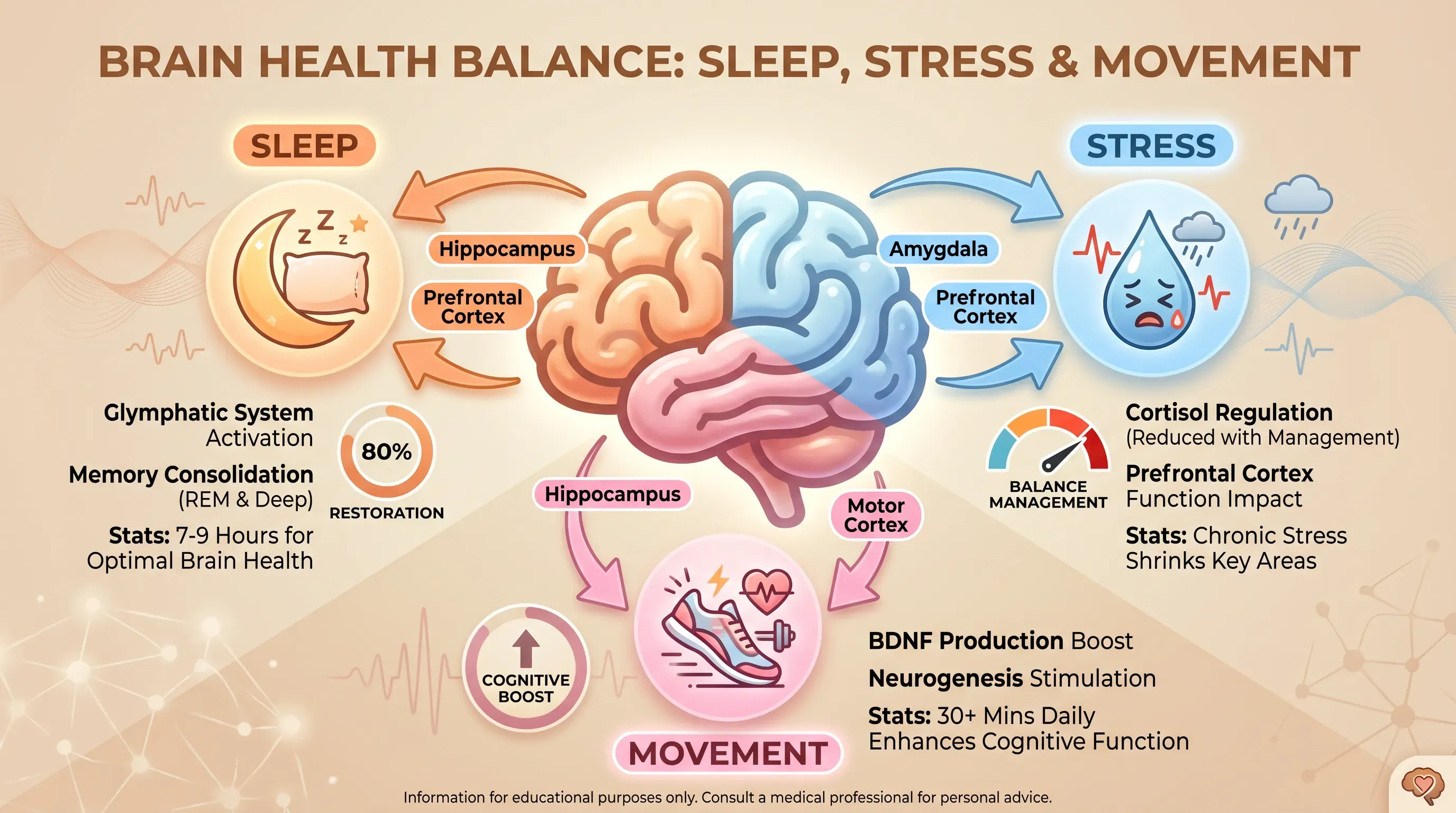
Warm medical infographic featuring a segmented brain icon with zones for Sleep, Stress, and Movement, using soft colors and simple icons.

Sleep quality and cortisol regulation decide whether cognition holds up or erodes, and exercise helps set that daily baseline. They're foundational because no nutrition plan compensates for four hours of broken sleep or unmanaged chronic stress. The brain treats these inputs as non-negotiable infrastructure.

The mechanisms differ but the message converges. Sleep clears metabolic waste through the glymphatic system. Cortisol regulation protects the hippocampus from atrophy. Aerobic and resistance exercise raise brain-derived neurotrophic factor (BDNF), the protein that supports neuroplasticity and learning. A Florida Atlantic University study on older adults at risk for Alzheimer's found that 26 weeks of structured aerobic training raised plasma cathepsin B, a myokine associated with hippocampal neurogenesis, and the increase correlated with verbal learning gains.

The practical implication is that lifestyle is the biological floor everything else stands on when it comes to cognition.

Ready to transform your health?

Book your health assessment with TNT Wellness personalized nutrition, functional medicine, and science-driven care to address the root causes of your symptoms.

Book Your Assessment →

How much sleep does the brain actually need?

Most adults need 7 to 9 hours, and the quality of those hours matters as much as the count. Deep sleep handles memory consolidation and physical restoration. REM sleep processes emotional information and supports creative problem-solving. Both stages need uninterrupted time to cycle properly. During sleep, the brain's glymphatic system flushes out metabolic waste such as amyloid-beta. According to research from the University of Rochester Medical Center, the glymphatic system is nearly 10 times more active during sleep than during wakefulness, with brain cells shrinking to allow waste removal.

The sleep hygiene basics work because they protect this cycle: consistent wake time, a cool dark bedroom, no screens for 60 minutes before bed, and caffeine cutoff by early afternoon. Skip these and the cleanup crew can't finish its shift.

How does chronic stress create brain fog?

Sustained stress dysregulates the hypothalamic-pituitary-adrenal (HPA) axis and keeps cortisol elevated when it should be falling. Chronically high cortisol shrinks the hippocampus, the brain's memory hub, and reduces prefrontal cortex activity, which is where focused thinking happens.

A 2020 paper in Molecular Psychiatry on persistent depressive symptoms linked HPA hyperactivity and inflammation to cognitive-affective and somatic symptoms and reinforced the loop between stress physiology and fuzzy thinking. The hippocampus doesn't repair itself overnight, but the loop is breakable. The tools that actually move cortisol are unglamorous. Slow nasal breathing for ten minutes activates the parasympathetic system. Twenty minutes outdoors in daylight resets circadian signaling. And honest boundary-setting around work and digital input removes the stimuli that keep cortisol high in the first place.

What kind of exercise improves focus fastest?

The fastest cognitive gains come from zone 2 cardio and resistance training, with short walking breaks during the workday used to restore attention between sessions. Zone 2 work (a pace where you can still hold a conversation) drives BDNF production. Resistance training improves insulin sensitivity, which steadies glucose delivery to the brain. Short walks between focused work blocks restore attention within minutes.

A systematic review and meta-analysis published in 2025 examined walking and cycling in older adults, with running evaluated alongside them, and found that each activity significantly raised circulating BDNF, with effect size influenced by baseline health status. My reading of the literature is that consistency outranks intensity for cognition. Three or four weekly sessions that combine cardio with two resistance days produce sharper cognition within weeks.

How does gut health influence the brain?

The gut and brain communicate constantly through the vagus nerve and the immune system, while microbe-derived metabolites serve as chemical messengers. When the gut is inflamed or its bacterial population is off-balance, it produces neuroactive compounds and inflammatory cytokines that cross into circulation and disrupt cognition. That is why bloating and irregular bowels appear alongside brain fog.

The vagus nerve is the main wire. According to a Frontiers in Psychiatry review by Bonaz and colleagues, the vagus modulates inflammation and links the gut's immune system to the hippocampus and amygdala, brain regions involved in mood regulation and memory under stress. Roughly 90% of vagal fibers carry signals from gut to brain.

The implication is direct. Repairing the gut (through fiber diversity, fermented foods, removing trigger foods, and treating any overgrowths) produces cognitive improvements that no amount of brain-targeted supplementation matches.

What functional lab tests reveal the root cause?

Targeted lab testing turns guessing into a protocol. Standard annual bloodwork rarely captures the markers that drive brain fog, which is why most people cycle through generic advice without finding their answer. Functional testing fills that gap by examining hormones, nutrients, gut function, and inflammation at a resolution conventional panels skip.

The value is in the specificity. Two people with identical symptoms can have entirely different root causes, and the protocol that fixes one won't touch the other. Testing pinpoints which lever to pull first, which is the difference between months of trial-and-error and a plan that works in weeks.

A quick orientation to the categories most worth running:

  • Comprehensive blood panel for nutrient status, thyroid, blood sugar, and inflammation

  • Hormone testing (DUTCH or salivary cortisol, sex hormone panels) when fatigue is present alongside mood or cycle changes

  • Comprehensive stool analysis and food sensitivity testing when gut symptoms accompany cognitive ones

  • Intracellular micronutrient and DNA panels for the persistent cases that resist obvious fixes

What does a comprehensive blood panel show?

A proper blood workup goes well past a basic metabolic panel and TSH. It includes full thyroid (TSH, free T3, free T4, reverse T3, and thyroid antibodies), B12, folate, vitamin D, ferritin for iron storage, fasting insulin and HbA1c for glucose handling, and hs-CRP for systemic inflammation.

Research published in Frontiers in Aging Neuroscience on hs-CRP and Alzheimer's disease found that elevated hs-CRP correlates with measurable changes in gray matter volume in the parahippocampal gyrus, a region central to memory. Standard labs rarely include hs-CRP, and they almost never include reverse T3 or thyroid antibodies. This matters because someone with a "normal" TSH can still have low free T3 or active autoimmune thyroiditis driving their fog. The deeper panel catches what the shallow one misses.

Ready to transform your health?

Book your health assessment with TNT Wellness personalized nutrition, functional medicine, and science-driven care to address the root causes of your symptoms.

Book Your Assessment →

When should you consider hormone or gut testing?

Specialized testing makes sense when symptoms cluster in patterns the standard panel can't explain. The DUTCH test maps cortisol's daily rhythm and sex hormone metabolites across a 24-hour window, which is far more useful than a single morning serum cortisol. Salivary cortisol rhythm testing covers similar ground at lower cost.

Sex hormone panels matter for women in their late 30s through 50s with cycle changes, and for men with fatigue or declining strength. According to research summarized in the World Journal of Psychiatry, 44% to 62% of women report subjective cognitive decline during the menopausal transition, and the right panel confirms which hormone shift is driving it. Comprehensive stool analysis and food sensitivity testing are worth running when bloating, irregular bowels, skin issues, or food reactions sit alongside the brain fog. The point is to match the test to the pattern.

How does micronutrient and DNA testing help?

Intracellular micronutrient testing measures what nutrients are actually doing inside the cell. Someone can have a normal serum B12 yet be functionally deficient at the tissue level, which is the version of deficiency that affects how you think.

DNA testing adds another layer. Variants in MTHFR (C677T and A1298C) reduce the body's ability to convert folate into its active 5-MTHF form, which affects neurotransmitter synthesis and homocysteine clearance. A Nature Translational Psychiatry review on MTHFR and psychiatric disease documents how these polymorphisms influence methylation and disease risk. APOE genotype informs Alzheimer's risk and shapes how aggressively to address lipid and inflammation drivers.

With this data in hand, supplementation becomes precise. Methylated folate instead of folic acid for MTHFR variants. Targeted nutrient repletion instead of broad-spectrum multivitamins.

How do hormones drive brain fog in men and women?

Estrogen, progesterone, testosterone, thyroid hormones, and cortisol all act directly on brain tissue, and imbalances in any of them produce cognitive symptoms. This is the piece most general brain fog articles skip, and it's the one that explains why an otherwise healthy 45-year-old can do everything "right" and still struggle to think clearly.

Hormones are signaling molecules with receptors throughout the brain. When the signal weakens or becomes erratic, the downstream effects show up as memory lapses and word-finding trouble, and processing speed slows too. Addressing the hormonal piece is what finally moves stubborn cases.

What causes brain fog in women?

For women, the dominant drivers are perimenopause and menopause, when estrogen and progesterone decline and fluctuate unpredictably. Estrogen supports neurotransmitter activity and synaptic connectivity in memory-related brain regions, which is why its withdrawal feels cognitive.

Thyroid dysfunction, particularly Hashimoto's autoimmune thyroiditis, affects women at roughly 8 times the rate it affects men and produces the same fuzzy thinking. Postpartum hormonal shifts add another window of vulnerability. Research published in Cleveland Clinic resources notes that estrogen fluctuations during perimenopause directly affect neurotransmitters and brain connectivity in regions responsible for memory and focus. What this means clinically is that a woman in her 40s with new brain fog deserves a hormonal workup before she's told it's stress or aging. The pattern is recognizable and treatable once it's named.

What causes brain fog in men?

Men's cognitive symptoms get attributed to stress or aging when the underlying cause is a slow testosterone decline that started in their 30s. Testosterone supports cerebral perfusion and mood, and low levels correlate with poorer performance on memory and executive function tests.

A longitudinal study summarized in PMC tracking men over 10.5 years found that those with lower testosterone levels had a 14% higher risk of developing dementia, with the Baltimore Longitudinal Study of Aging showing better cognitive performance in men with a higher testosterone-to-SHBG ratio. Chronic stress compounds the problem by elevating cortisol, which suppresses testosterone production. Thyroid issues in men are underdiagnosed because the symptoms get attributed to overwork. The practical point is that men deserve the same hormonal workup women get when cognition slips. The contributors are real and the labs are inexpensive.

When is bioidentical hormone therapy appropriate?

Bioidentical hormone replacement therapy fits patients with documented deficiencies and symptoms that match the lab picture, when the benefit-to-risk profile makes sense for their history. Bioidentical formulations are molecularly identical to the hormones the body produces, which is why many clinicians prefer them for replacement protocols.

The American College of Obstetricians and Gynecologists distinguishes between FDA-approved bioidentical products (such as micronized progesterone and estradiol) and custom-compounded preparations. According to ACOG's clinical consensus, FDA-approved bioidentical options have the strongest evidence base, while compounded versions require careful clinician oversight because they're not FDA-regulated.

The non-negotiable part is supervision. Hormone therapy without baseline labs and periodic monitoring is a setup for problems, especially when dose adjustment is missing. With proper oversight, it's one of the more effective tools for hormonally driven brain fog.

What does a realistic action plan look like?

The sequence that works is boring on purpose. Start with sleep and blood sugar because they're the foundation everything else builds on, and improvements show up within days. Run targeted labs next so the rest of the protocol matches the actual drivers.

From there, layer in nutrition shifts that protect glucose stability and supply the nutrients the brain runs on. Add gut repair if stool testing or symptoms point that direction. Address hormones last, once the foundational work is in place, because hormone therapy works better once sleep and nutrition are steady and regular movement is in place.

A realistic order of operations looks like this:

  1. Stabilize sleep timing and blood sugar pairing for two to four weeks

  2. Run a comprehensive blood panel with full thyroid, nutrients, insulin, and hs-CRP

  3. Adjust nutrition based on findings and add targeted supplementation

  4. Investigate gut function or food sensitivities if symptoms persist

  5. Add hormone or DNA testing if the picture still isn't complete

  6. Layer in bioidentical hormone support under clinical supervision when indicated

The value of the sequence is that each step makes the next one more effective. Skipping ahead means redoing the work.

Work with TNT Wellness to clear brain fog at the root

If the path above looks like the right approach but you'd rather not piece it together alone, TNT Wellness was built for exactly this workflow. The practice combines in-depth assessments with functional lab testing across hormones, gut function, food sensitivities, intracellular micronutrients, and DNA, then translates the data into a plan you can actually follow.

You work one-on-one with registered dietitians and medical providers who handle the clinical interpretation and adjust the protocol as your labs and symptoms change. Customized nutrition plans and wellness coaching are available when the findings call for them, and bioidentical hormone replacement therapy is delivered by the same team in one coordinated workflow.

Visits are flexible. You can see the team virtually or in person, and insurance is accepted for eligible services. To take the next step, schedule a consultation with TNT Wellness and bring whatever recent labs you have. The first conversation maps out which tests fit your case and what an initial protocol would look like.

Ready to transform your health?

Book your health assessment with TNT Wellness personalized nutrition, functional medicine, and science-driven care to address the root causes of your symptoms.

Book Your Assessment →

Early improvement can happen within 1 to 2 weeks when sleep timing and blood sugar are stabilized. Nutrient repletion, gut repair, or hormone correction usually takes longer because labs must guide the plan. Track focus, energy, sleep, and meals daily so you can see which changes move symptoms.

Yes, dehydration can cause brain fog because fluid loss affects blood volume, electrolyte balance, and oxygen delivery to the brain. Start by checking urine color and thirst patterns. Pale yellow urine, regular water intake, and added electrolytes after sweating are practical targets for daily clarity.

Don’t start high-dose supplements before baseline labs unless a clinician has told you to. Supplements can change blood markers and make it harder to identify the original deficiency. A safer approach is to test first, then match the dose and form to your actual results.

See a clinician if brain fog lasts longer than 2 to 4 weeks, worsens, or appears with fatigue, mood changes, gut symptoms, or cycle changes. Seek urgent care for sudden confusion, weakness, severe headache, chest pain, fainting, or trouble speaking. Those signs need immediate medical evaluation.

Caffeine can improve alertness for a short time, but it worsens brain fog when it replaces sleep, raises anxiety, or is taken late in the day. Keep it to the morning, take it with food if you’re sensitive, and stop by early afternoon to protect sleep quality.

Schedule a Meeting

Book a time that works best for you

You Might Also Like

Discover more insights and articles

Minimalist skincare and cosmetic products arranged on a bright modern countertop with soft natural sunlight and indoor plants

Boosting Mood, Energy, and Libido for Women Over 40

In this article, we explain the underlying hormonal mechanisms of midlife transitions and show how targeted lifestyle strategies restore vitality. We also explore functional testing, metabolic nutrition, and circadian-aligned exercise.

A female doctor in a bright, modern office uses a tablet to review patient information, focused on her task in a professional setting.

Digestive Health Assessment: Symptoms, History, Tests, and Next Steps

This article explains how a structured review of your symptoms and history turns vague gut complaints into decisions you can act on. It covers what a practitioner asks about and which warning signs need medical attention first, so you can walk into an appointment with the information that actually changes the outcome.

A female nutritionist in a bright, minimalist office discusses treatment plans with a patient, using a tablet displaying healthcare data.

Functional Medicine Consultation: How to Prepare and What Happens Next

This article covers what to bring to a first functional medicine consultation and what actually happens during and after the visit. It also explains why testing sometimes comes later than people expect, and what a realistic plan looks like when you walk out.

A woman doctor consults with a patient, shown from behind, in a warm, upscale medical office with natural lighting and soft colors.

How to Choose a Gut Health Specialist for Persistent Digestive Symptoms

This article explains how to pick the right provider when bloating or unpredictable bowel habits have stopped being occasional. It walks through the warning signs that need medical attention now and what each type of provider is actually trained to do.